Getting Started with Kompot
This tutorial introduces Kompot’s core functionality for differential analysis in single-cell data. You’ll learn how to:
Perform differential abundance (DA) analysis to identify cell states that change between conditions
Conduct differential expression (DE) analysis to find genes with altered expression
Visualize and interpret results using Kompot’s plotting tools
What Makes Kompot Different?
Kompot uses Mahalanobis distance to detect expression differences while accounting for the covariance structure of gene expression. This approach is particularly powerful for:
Detecting subtle changes along continuous cell state trajectories
Identifying genes with complex, coordinated expression patterns
Analyzing data where discrete cell type labels are inadequate
Dataset
We’ll analyze murine bone marrow cells comparing Young vs. Old mice to understand how aging affects hematopoietic stem cells and their derivatives.
[1]:
import anndata as ad
import matplotlib.pyplot as plt
import numpy as np
import palantir
import pandas as pd
import scanpy as sc
import seaborn as sns

import kompot

# Set plotting style
plt.rcParams["axes.spines.right"] = False
plt.rcParams["axes.spines.top"] = False
plt.rcParams["image.cmap"] = "Spectral_r"
Configuration
Define analysis parameters. Adapt these to your own data:
[2]:
DATA_PATH = "../data/murine_bone_marrow_aging.h5ad"
GROUPING_COLUMN = "Age"              # Condition column in adata.obs
CONDITIONS = ["Young", "Old"]        # First condition is reference
CELL_TYPE_COLUMN = "highres_celltype"  # Optional: for visualization only
DIMENSIONALITY_REDUCTION = "DM_EigenVectors"  # Cell state representation
LAYER_FOR_EXPRESSION = "logged_counts"        # Expression data layer
Load Data
The dataset will be downloaded automatically from Zenodo if not already present:
[3]:
import os
from pathlib import Path
import requests
from tqdm.auto import tqdm

Path(DATA_PATH).parent.mkdir(parents=True, exist_ok=True)

if not os.path.exists(DATA_PATH):
    print("Downloading dataset...")
    url = "https://zenodo.org/records/15587768/files/murine_bone_marrow_aging.h5ad?download=1"
    response = requests.get(url, stream=True)
    total = int(response.headers.get("content-length", 0))

    with open(DATA_PATH, "wb") as file, tqdm(total=total, unit="B", unit_scale=True) as bar:
        for chunk in response.iter_content(chunk_size=8192):
            file.write(chunk)
            bar.update(len(chunk))

adata = ad.read_h5ad(DATA_PATH)
adata
[3]:
AnnData object with n_obs × n_vars = 8090 × 16285
    obs: 'Compartment', 'Replicate', 'Age', 'Sample', 'Info', 'batch', 'doublet_score', 'n_genes_by_counts', 'total_counts', 'total_counts_mt', 'pct_counts_mt', 'total_counts_hb', 'pct_counts_hb', 'S_score', 'G2M_score', 'phase', 'leiden', 'phenograph', 'highres_celltype', 'midres_celltype'
    var: 'gene_ids', 'feature_types', 'genome', 'mt', 'n_cells_by_counts', 'mean_counts', 'pct_dropout_by_counts', 'total_counts', 'hb', 'highly_variable', 'means', 'dispersions', 'dispersions_norm', 'highly_variable_nbatches', 'highly_variable_intersection'
    uns: 'Age_colors', 'Compartment_colors', 'DMEigenValues', 'Info_colors', 'README', 'Replicate_colors', 'Sample_colors', 'batch_colors', 'draw_graph', 'highres_celltype_colors', 'hvg', 'leiden', 'leiden_colors', 'midres_celltype_colors', 'neighbors', 'pca', 'phase_colors', 'umap'
    obsm: 'AbCapture', 'DM_EigenVectors', 'HTO', 'X_draw_graph_fa', 'X_pca', 'X_pca_harmony', 'X_pca_noregression', 'X_umap'
    varm: 'PCs'
    layers: 'MAGIC_imputed_data', 'logged_counts', 'normalized_counts', 'raw_counts'
    obsp: 'DM_Kernel', 'connectivities', 'distances'
Data Exploration
Before analysis, examine the data structure and distribution:
[4]:
sc.pl.umap(adata, color=[CELL_TYPE_COLUMN, GROUPING_COLUMN], frameon=False, wspace=1.3)
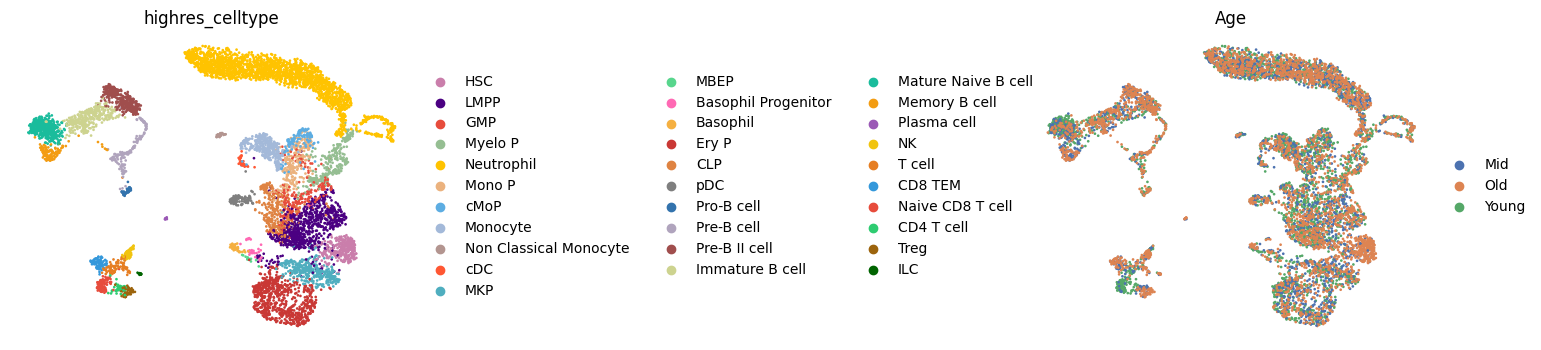
If you have a clustering or cell-type annotation, cell type composition can provide a rough understanding of the data and help identify underrepresented cell types that could complicate differential expression analysis.
[5]:
crosstab = (
    pd.crosstab(
        adata.obs[CELL_TYPE_COLUMN], adata.obs[GROUPING_COLUMN], normalize="index"
    )
    * 100
)

# Plot the distribution
ax = crosstab.plot(kind="bar", stacked=False, figsize=(12, 8))
ax.grid(False)
plt.xlabel("Cell Type")
plt.ylabel("Percentage (%)")
plt.title("Cell Type Distribution by Condition")
plt.legend(title=GROUPING_COLUMN)
plt.xticks(rotation=90)
plt.tight_layout()
plt.show()

# Print extremes (cell types with high bias toward one condition)
bias_threshold = 75  # Percentage threshold for considering a cell type biased
biased_types = crosstab[(crosstab > bias_threshold).any(axis=1)]

if not biased_types.empty:
    print(f"Cell types with >={bias_threshold}% bias toward one condition:")
    print(biased_types)
    print("\nThese cell types might show disproportionate changes between conditions.")
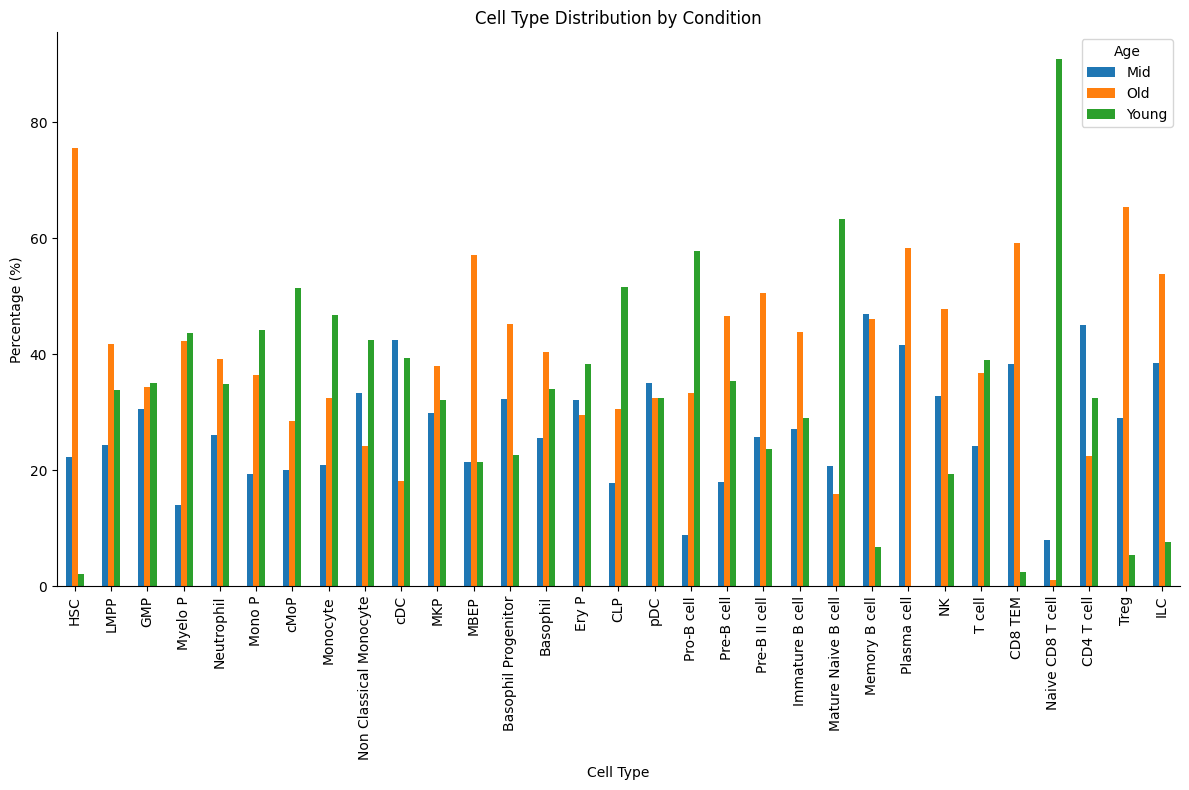
Cell types with >=75% bias toward one condition:
Age                     Mid        Old      Young
highres_celltype
HSC               22.257053  75.548589   2.194357
Naive CD8 T cell   8.000000   1.000000  91.000000

These cell types might show disproportionate changes between conditions.
Diffusion Maps Preprocessing
Kompot requires a continuous representation of cell states. Palantir diffusion maps capture the geometry of differentiation trajectories while reducing noise:
[6]:
palantir.utils.run_diffusion_maps(adata, pca_key="X_pca_harmony", n_components=40);
/fh/fast/setty_m/user/dotto/kompot/.venv/lib/python3.12/site-packages/joblib/externals/loky/backend/context.py:131: UserWarning: Could not find the number of physical cores for the following reason:
found 0 physical cores < 1
Returning the number of logical cores instead. You can silence this warning by setting LOKY_MAX_CPU_COUNT to the number of cores you want to use.
  warnings.warn(
  File "/fh/fast/setty_m/user/dotto/kompot/.venv/lib/python3.12/site-packages/joblib/externals/loky/backend/context.py", line 255, in _count_physical_cores
    raise ValueError(f"found {cpu_count_physical} physical cores < 1")
Differential Abundance Analysis
Identify cell states that change in frequency between conditions.
See kompot.da for full documentation.
[7]:
da_results = kompot.da(
    adata,
    groupby=GROUPING_COLUMN,
    condition1=CONDITIONS[0],
    condition2=CONDITIONS[1],
    obsm_key=DIMENSIONALITY_REDUCTION,
)
[2026-03-26 05:05:44,501] [INFO    ] Condition 1 (Young): 2,917 cells
[2026-03-26 05:05:44,502] [INFO    ] Condition 2 (Old): 3,116 cells
[2026-03-26 05:05:44,506] [INFO    ] Fitting density estimator for condition 1...
[2026-03-26 05:06:09,199] [INFO    ] Fitting density estimator for condition 2...
[2026-03-26 05:06:26,116] [INFO    ] This run will have `run_id=0`.
Visualize Abundance Changes
Results are stored in adata.obs:
kompot_da_Young_to_Old_lfc: Log fold change (positive = enriched in Old)kompot_da_Young_to_Old_lfc_direction: Categorical classification (up/down/unchanged)
[8]:
sc.pl.embedding(
    adata, "umap",
    color=[f"kompot_da_{CONDITIONS[0]}_to_{CONDITIONS[1]}_lfc_direction", f"kompot_da_{CONDITIONS[0]}_to_{CONDITIONS[1]}_lfc"],
    color_map="RdBu_r",
    vcenter=0,
    frameon=False,
)

Volcano Plot
Volcano plots for differential abundance show effect size (x-axis) vs. statistical significance (y-axis):
[9]:
kompot.plot.volcano_da(adata, color=CELL_TYPE_COLUMN)
[2026-03-26 05:06:26,496] [INFO    ] Found DA run info for run_id=-1
[2026-03-26 05:06:26,497] [INFO    ] Found lfc_key='kompot_da_Young_to_Old_lfc' from run info
[2026-03-26 05:06:26,498] [INFO    ] Found ptp_key='kompot_da_Young_to_Old_neg_log10_lfc_ptp' from run info
[2026-03-26 05:06:26,500] [INFO    ] Successfully inferred fields: {'lfc_key': 'kompot_da_Young_to_Old_lfc', 'ptp_key': 'kompot_da_Young_to_Old_neg_log10_lfc_ptp'}
[2026-03-26 05:06:26,500] [INFO    ] Using inferred thresholds - lfc_threshold: 1.0, ptp_threshold: 0.05
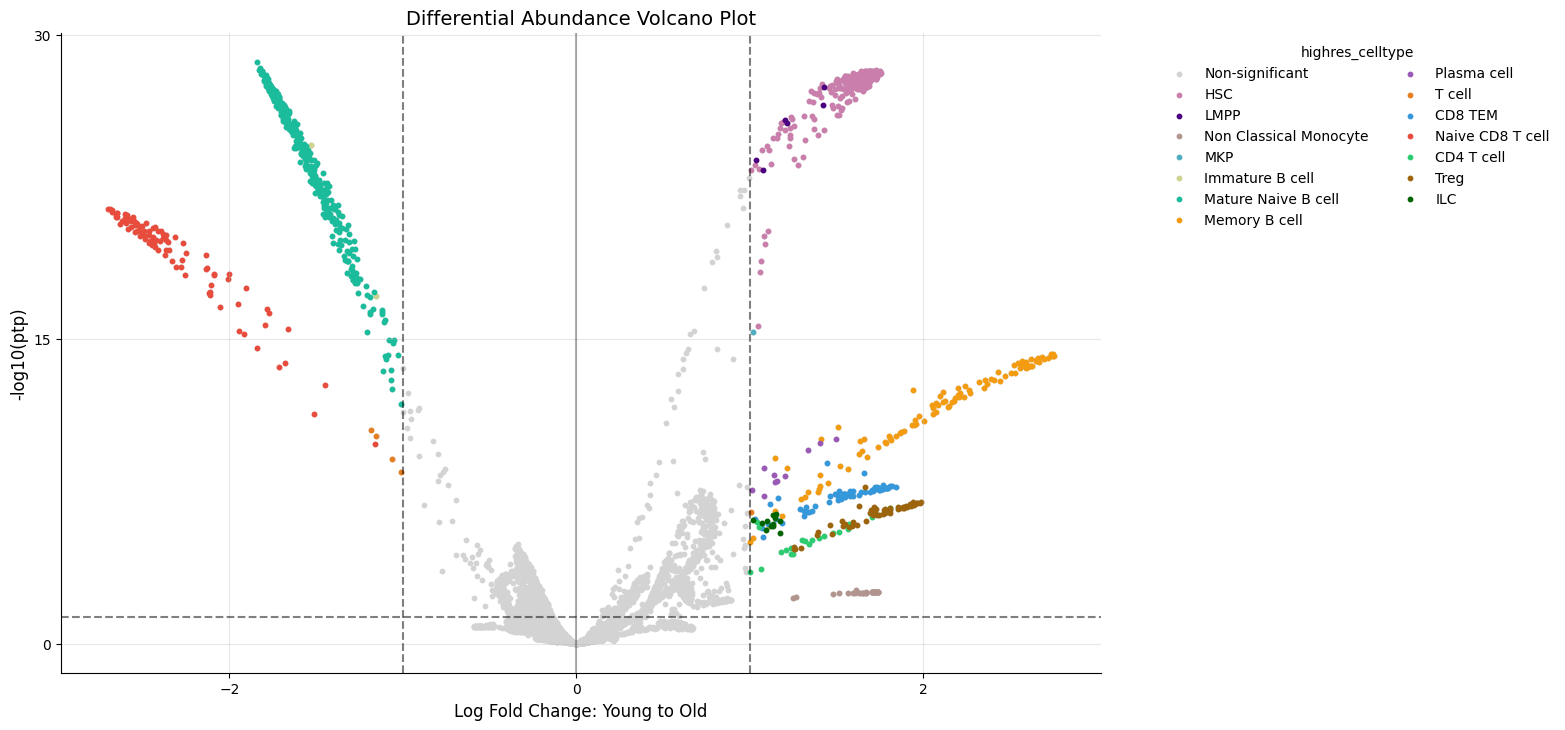
Points above the horizontal line and outside vertical lines are significantly changed.
Adjust thresholds using ptp_threshold and lfc_threshold parameters. Use update_direction=True to update the classification in adata.obs.
[10]:
# Visualize only significantly changed cells
kompot.plot.embedding(
    adata, "umap",
    color=[CELL_TYPE_COLUMN, f"kompot_da_{CONDITIONS[0]}_to_{CONDITIONS[1]}_lfc"],
    groups={f"kompot_da_{CONDITIONS[0]}_to_{CONDITIONS[1]}_lfc_direction": ["up", "down"]},
    frameon=False,
    wspace=.5,
)
[2026-03-26 05:06:27,096] [INFO ] Selected 1,075 cells out of 8,090 total cells.
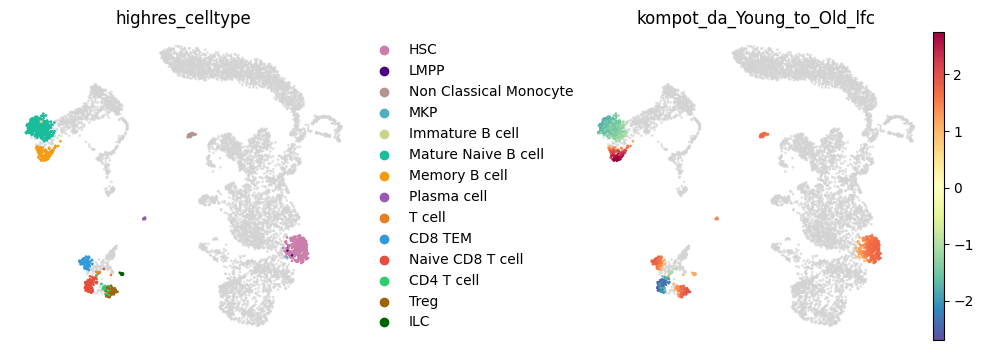
The mgroups parameter in the kompot.plot.embedding function allows plotting increasing and decreasing cell types separately:
[11]:
kompot.plot.embedding(
    adata,
    "umap",
    color=CELL_TYPE_COLUMN,
    mgroups=[{f"kompot_da_{CONDITIONS[0]}_to_{CONDITIONS[1]}_lfc_direction":[d]} for d in ["up", "down"]],
    frameon=False,
    wspace=.5,
)
[2026-03-26 05:06:27,853] [INFO    ] Selected 585 cells out of 8,090 total cells.
[2026-03-26 05:06:27,952] [INFO    ] Selected 490 cells out of 8,090 total cells.

Summary by Cell Type
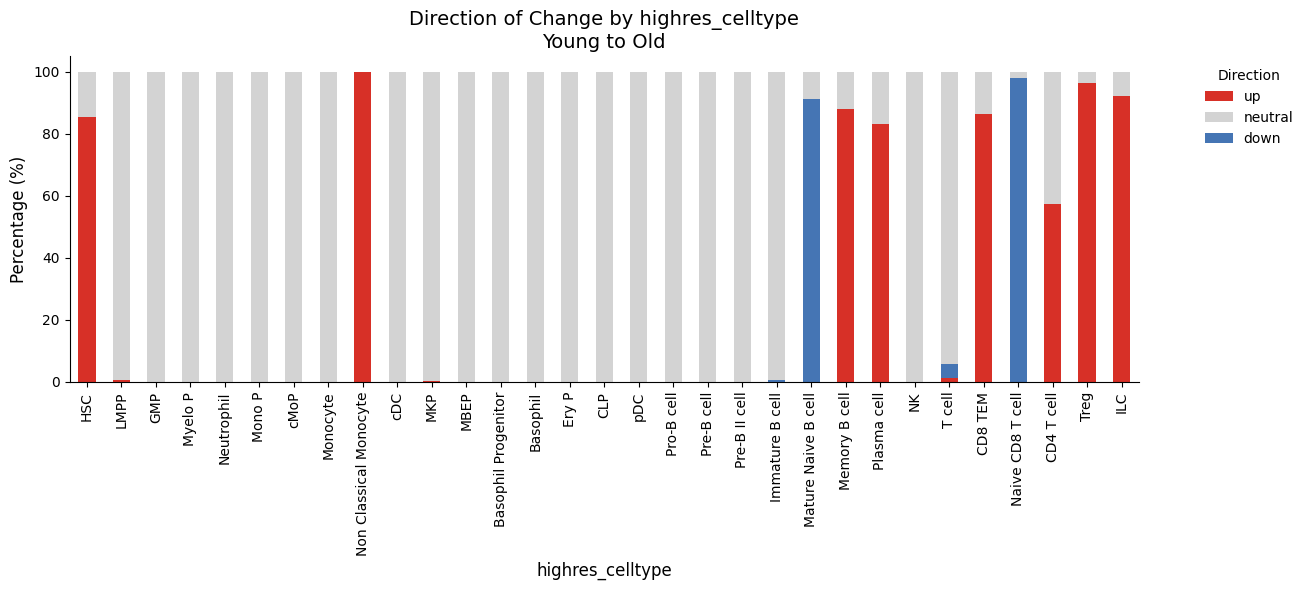
Aggregate abundance changes by cell type with the direction_barplot:
[12]:
kompot.plot.direction_barplot(adata, category_column=CELL_TYPE_COLUMN)
[2026-03-26 05:06:28,529] [INFO    ] Found DA run info for run_id=-1
[2026-03-26 05:06:28,530] [INFO    ] Found direction_key='kompot_da_Young_to_Old_lfc_direction' from run info
[2026-03-26 05:06:28,531] [INFO    ] Successfully inferred fields: {'direction_key': 'kompot_da_Young_to_Old_lfc_direction'}
[2026-03-26 05:06:28,532] [INFO    ] Using DA run 0 for direction_barplot: comparing Young to Old
[2026-03-26 05:06:28,533] [INFO    ] Creating direction barplot: comparing Young to Old
[2026-03-26 05:06:28,534] [INFO    ] Using fields - category_column: 'highres_celltype', direction_column: 'kompot_da_Young_to_Old_lfc_direction'
Differential Expression Analysis
Identify genes that change in expression between conditions.
The batch_size parameter in GPSettings controls peak memory usage during prediction. Set it to 0 to process all cells at once (fastest, but uses most memory), or to e.g. 100 to process in batches (slower, but much lower memory footprint). For large datasets, start with batch_size=100 and increase if memory allows.
See kompot.de for full documentation.
[13]:
de_results = kompot.de(
    adata,
    groupby=GROUPING_COLUMN,
    condition1=CONDITIONS[0],
    condition2=CONDITIONS[1],
    layer=LAYER_FOR_EXPRESSION,
    obsm_key=DIMENSIONALITY_REDUCTION,
    gp=kompot.GPSettings(batch_size=0),  # 0 = all cells at once; increase for lower memory
)
[2026-03-26 05:06:28,988] [INFO    ] Condition 1 (Young): 2,917 cells
[2026-03-26 05:06:28,989] [INFO    ] Condition 2 (Old): 3,116 cells
[2026-03-26 05:06:32,589] [INFO    ] Fitting expression estimator for condition 1...
[2026-03-26 05:06:37,078] [INFO    ] Fitting expression estimator for condition 2...
[2026-03-26 05:07:22,007] [INFO    ] FDR analysis complete: 192/16285 genes significantly DE at FDR < 0.05
[2026-03-26 05:07:22,010] [INFO    ] Mahalanobis distance threshold for FDR < 0.05: 27.3487
[2026-03-26 05:07:26,143] [INFO    ] This run will have `run_id=0`.
Resource Planning
For larger datasets or production workflows, you may want to optimize memory usage and computational resources. See the Resource Planning section in Tutorial 2 for more detailed guidance.
Results Interpretation
Results are stored in adata.var:
kompot_de_Young_to_Old_mean_lfc: Average log fold changekompot_de_Young_to_Old_mahalanobis: Statistical significance (higher = more significant)kompot_de_Young_to_Old_is_de: Boolean flag for significant genes (FDR < 0.05)
The Mahalanobis distance accounts for covariance structure and is more sensitive than simple fold change.
[14]:
# Top differentially expressed genes
adata.var.loc[
    :, adata.var.columns.str.contains("kompot_de")
].sort_values(
    f"kompot_de_{CONDITIONS[0]}_to_{CONDITIONS[1]}_mahalanobis", ascending=False
).head(20)
[14]:
| kompot_de_Young_to_Old_mahalanobis | kompot_de_Young_to_Old_mean_lfc | kompot_de_Young_to_Old_mahalanobis_local_fdr | kompot_de_Young_to_Old_is_de | |
|---|---|---|---|---|
| H2-Q7 | 71.525389 | 1.235127 | 1.283051e-141 | True |
| Cd74 | 60.045402 | 0.352017 | 1.641288e-80 | True |
| H2-Aa | 59.386737 | 0.473619 | 2.138015e-77 | True |
| H2-Ab1 | 57.821672 | 0.510985 | 1.587428e-70 | True |
| Igkc | 53.632533 | 0.053961 | 1.449781e-53 | True |
| H2-Eb1 | 53.420015 | 0.411615 | 8.317419e-53 | True |
| AW112010 | 53.397625 | 0.791454 | 1.114916e-52 | True |
| S100a9 | 48.791349 | -0.170284 | 5.227218e-37 | True |
| Ifitm3 | 47.608968 | 0.367547 | 1.495789e-33 | True |
| S100a8 | 47.399107 | -0.165096 | 5.666264e-33 | True |
| H2-Q6 | 45.994874 | 0.782328 | 4.653634e-29 | True |
| Cd52 | 45.333064 | -0.127924 | 2.354772e-27 | True |
| Aldh1a1 | 44.598796 | 0.490844 | 1.680908e-25 | True |
| Ifitm1 | 44.342628 | 0.427746 | 7.277377e-25 | True |
| Ifitm2 | 43.962176 | 0.285812 | 5.729668e-24 | True |
| Ighm | 43.241943 | -0.173795 | 3.048712e-22 | True |
| Cd79a | 43.137389 | -0.004366 | 5.438479e-22 | True |
| Apoe | 42.951821 | -0.131219 | 1.452203e-21 | True |
| Fos | 42.280562 | 0.531505 | 4.706711e-20 | True |
| Gm47283 | 41.955531 | 0.627169 | 2.573640e-19 | True |
Volcano Plot
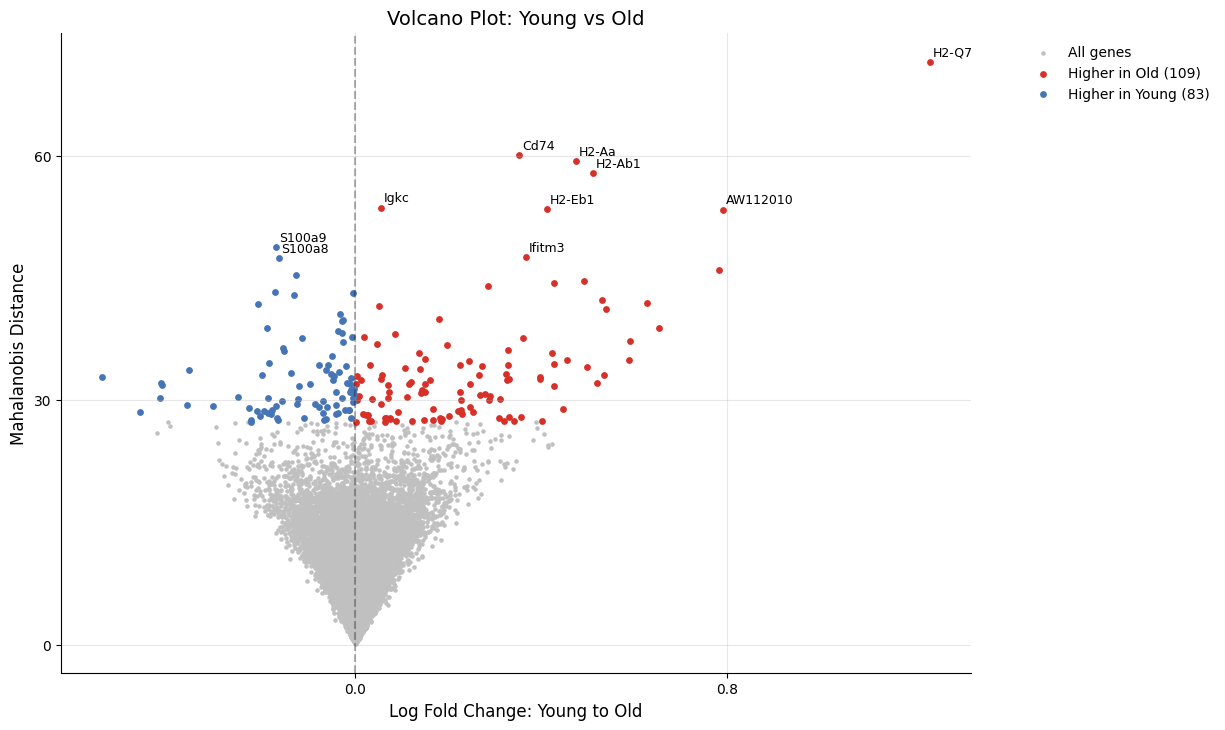
Visualize effect size vs. significance for differential expression with the volcano_de plot:
[15]:
kompot.plot.volcano_de(adata)
[2026-03-26 05:07:26,577] [INFO    ] Found DE run info for run_id=-1
[2026-03-26 05:07:26,578] [INFO    ] Found mean_lfc_key='kompot_de_Young_to_Old_mean_lfc' from run info
[2026-03-26 05:07:26,579] [INFO    ] Found mahalanobis_key='kompot_de_Young_to_Old_mahalanobis' from run info
[2026-03-26 05:07:26,580] [INFO    ] Successfully inferred fields: {'mean_lfc_key': 'kompot_de_Young_to_Old_mean_lfc', 'mahalanobis_key': 'kompot_de_Young_to_Old_mahalanobis'}
[2026-03-26 05:07:26,581] [INFO    ] Using DE run 0: comparing Young to Old
[2026-03-26 05:07:26,598] [INFO    ] Using data columns from var - lfc: 'kompot_de_Young_to_Old_mean_lfc', score: 'kompot_de_Young_to_Old_mahalanobis'
[2026-03-26 05:07:26,602] [INFO    ] Highlighting 192 genes marked as DE (109 up, 83 down)
[2026-03-26 05:07:26,614] [INFO    ] Labeling top 10 genes by score
Fold Change Heatmap
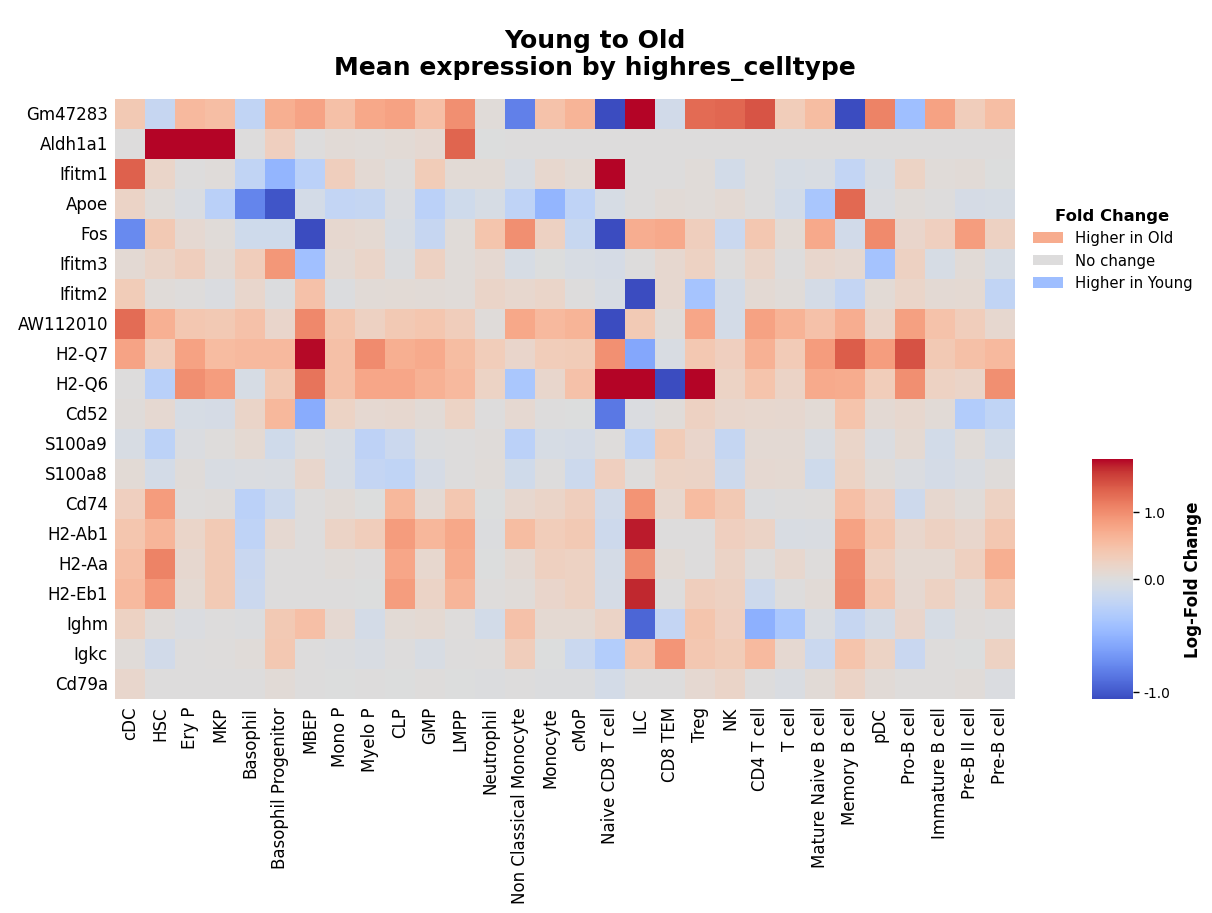
Visualize fold changes across top differentially expressed genes with a heatmap. This provides a complementary view to the volcano plot, showing the magnitude and direction of expression changes.
Note that the gene selection is based on Kompot’s Mahalanobis distance (statistical significance), but the fold changes displayed are simply the difference of mean expressions from the input expression layer (in this case logged_counts), not a Kompot-specific metric:
[16]:
# Selecting top 20 genes
genes = adata.var[f"kompot_de_{CONDITIONS[0]}_to_{CONDITIONS[1]}_mahalanobis"].sort_values(ascending=False).head(20).index

kompot.plot.heatmap(
    adata,
    genes=genes,
    groupby=CELL_TYPE_COLUMN,        # Aggregate expression by cell type
    exclude_groups="Plasma cell",    # Remove cell types with too little representation
    vmin="p1",                       # Color scale minimum at 1st percentile (handles outliers)
    vmax="p99",                      # Color scale maximum at 99th percentile
    fold_change_mode=True,           # Display fold changes instead of mean expression
)
[2026-03-26 05:07:26,879] [INFO    ] Inferred condition_column='Age' from run information
[2026-03-26 05:07:26,880] [INFO    ] Inferred condition1='Young' from run information
[2026-03-26 05:07:26,881] [INFO    ] Inferred condition2='Old' from run information
[2026-03-26 05:07:26,882] [INFO    ] Inferred layer='logged_counts' from run information
[2026-03-26 05:07:26,883] [INFO    ] Creating fold change heatmap with 20 genes/features
[2026-03-26 05:07:26,885] [INFO    ] Using expression data from layer: 'logged_counts'
[2026-03-26 05:07:26,958] [INFO    ] Excluded 7 cells from groups: Plasma cell
[2026-03-26 05:07:26,965] [INFO    ] Applying gene-wise z-scoring (standard_scale='var')
[2026-03-26 05:07:27,037] [WARNING ] standard_scale is ignored in fold_change_mode as z-scoring is not appropriate for fold changes
[21]:
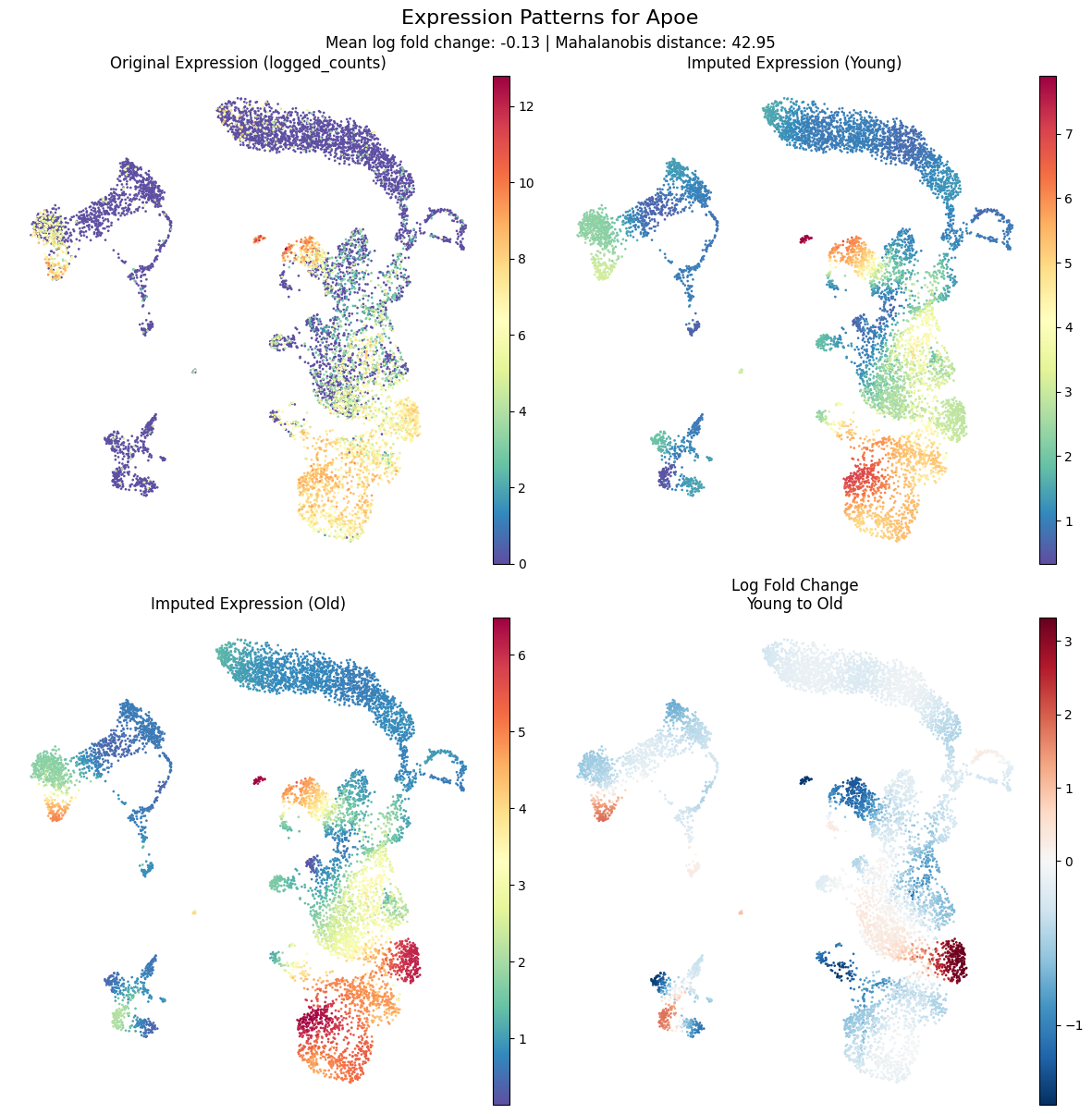
kompot.plot.plot_gene_expression(
    adata, gene="Apoe", frameon=False
)
[2026-03-27 01:03:17,660] [INFO    ] Found DE run info for run_id=-1
[2026-03-27 01:03:17,662] [INFO    ] Found mean_lfc_key='kompot_de_Young_to_Old_mean_lfc' from run info
[2026-03-27 01:03:17,664] [INFO    ] Found mahalanobis_key='kompot_de_Young_to_Old_mahalanobis' from run info
[2026-03-27 01:03:17,666] [INFO    ] Successfully inferred fields: {'mean_lfc_key': 'kompot_de_Young_to_Old_mean_lfc', 'mahalanobis_key': 'kompot_de_Young_to_Old_mahalanobis'}
[2026-03-27 01:03:17,667] [INFO    ] Using DE run 0: comparing Young to Old
[2026-03-27 01:03:17,669] [INFO    ] Using fields for gene expression plot - lfc_key: 'kompot_de_Young_to_Old_mean_lfc', score_key: 'kompot_de_Young_to_Old_mahalanobis'
[2026-03-27 01:03:17,670] [INFO    ] Using layer 'logged_counts' inferred from run information
[2026-03-27 01:03:17,673] [INFO    ] Using imputed layer 'kompot_de_Young_imputed' for 'Young'
[2026-03-27 01:03:17,674] [INFO    ] Using imputed layer 'kompot_de_Old_imputed' for 'Old'
[2026-03-27 01:03:17,674] [INFO    ] Using fold_change layer 'kompot_de_Young_to_Old_fold_change' from run_info
Functional Enrichment
Use StringDBReport to analyze gene sets using STRING database:
Privacy Note: This sends gene lists to the STRING database API. If working with sensitive data, consider local alternatives.
[ ]:
# Selecting all significantly different genes
genes = adata.var_names[adata.var[f"kompot_de_{CONDITIONS[0]}_to_{CONDITIONS[1]}_is_de"]]

# Create STRING report
report = kompot.plot.StringDBReport(
    genes,
    species_id=10090, # 10090 = Mus musculus, 9606 = Homo Sapiens
    include_enrichment=True
)
report
[19]:
# Get enriched functional categories
report.get_functional_enrichment("Function").head(10)
[19]:
| category | term | number_of_genes | number_of_genes_in_background | ncbiTaxonId | inputGenes | preferredNames | p_value | fdr | description | expected | strength | signal | |
|---|---|---|---|---|---|---|---|---|---|---|---|---|---|
| 774 | Function | GO:0042605 | 10 | 31 | 10090 | [H2-K1, H2-Ab1, H2-Aa, H2-Q7, H2-T22, H2-Q4, H... | [H2-K1, H2-Ab1, H2-Aa, H2-Q7, H2-T22, H2-Q4, H... | 1.600000e-12 | 3.910000e-09 | Peptide antigen binding | 0.281818 | 1.550031 | 0.899806 |
| 772 | Function | GO:0003823 | 12 | 63 | 10090 | [H2-K1, H2-Ab1, H2-Aa, H2-Q7, H2-T22, H2-Q4, H... | [H2-K1, H2-Ab1, H2-Aa, H2-Q7, H2-T22, H2-Q4, H... | 1.940000e-12 | 3.910000e-09 | Antigen binding | 0.572727 | 1.321233 | 0.680418 |
| 777 | Function | GO:0042608 | 8 | 31 | 10090 | [H2-K1, H2-Q7, H2-T22, H2-Q4, H2-T23, Lck, H2-... | [H2-K1, H2-Q7, H2-T22, H2-Q4, H2-T23, Lck, H2-... | 1.290000e-09 | 9.050000e-07 | T cell receptor binding | 0.281818 | 1.453121 | 0.678800 |
| 780 | Function | GO:0042610 | 7 | 24 | 10090 | [H2-K1, H2-Q7, H2-T22, H2-Q4, H2-T23, Lck, H2-Q6] | [H2-K1, H2-Q7, H2-T22, H2-Q4, H2-T23, Lck, H2-Q6] | 7.010000e-09 | 3.440000e-06 | CD8 receptor binding | 0.218182 | 1.506279 | 0.672675 |
| 782 | Function | GO:0046979 | 7 | 25 | 10090 | [H2-K1, H2-Q7, H2-T22, H2-Q4, H2-T23, Tap1, H2... | [H2-K1, H2-Q7, H2-T22, H2-Q4, H2-T23, Tap1, H2... | 8.910000e-09 | 3.920000e-06 | TAP2 binding | 0.227273 | 1.488551 | 0.657889 |
| 783 | Function | GO:0046978 | 7 | 26 | 10090 | [H2-K1, H2-Q7, H2-T22, H2-Q4, H2-T23, Tap1, H2... | [H2-K1, H2-Q7, H2-T22, H2-Q4, H2-T23, Tap1, H2... | 1.120000e-08 | 4.230000e-06 | TAP1 binding | 0.236364 | 1.471517 | 0.645364 |
| 775 | Function | GO:0042287 | 10 | 52 | 10090 | [H2-K1, Cd81, Cd8b1, H2-Q7, H2-T22, H2-Q4, Cd7... | [H2-K1, Cd81, Cd8b1, H2-Q7, H2-T22, H2-Q4, Cd7... | 1.310000e-10 | 1.280000e-07 | MHC protein binding | 0.472727 | 1.325389 | 0.628116 |
| 781 | Function | GO:0042288 | 8 | 41 | 10090 | [H2-K1, Cd8b1, H2-Q7, H2-T22, H2-Q4, H2-T23, T... | [H2-K1, Cd8b1, H2-Q7, H2-T22, H2-Q4, H2-T23, T... | 8.800000e-09 | 3.920000e-06 | MHC class I protein binding | 0.372727 | 1.331699 | 0.562132 |
| 788 | Function | GO:0030881 | 6 | 25 | 10090 | [H2-K1, H2-Q7, H2-T22, H2-Q4, H2-T23, H2-Q6] | [H2-K1, H2-Q7, H2-T22, H2-Q4, H2-T23, H2-Q6] | 2.340000e-07 | 6.040000e-05 | beta-2-microglobulin binding | 0.227273 | 1.421604 | 0.532037 |
| 786 | Function | GO:0071889 | 8 | 55 | 10090 | [Zfp36l1, H2-K1, Zfp36, H2-Q7, H2-T22, H2-Q4, ... | [Zfp36l1, H2-K1, Zfp36, H2-Q7, H2-T22, H2-Q4, ... | 6.820000e-08 | 1.970000e-05 | 14-3-3 protein binding | 0.500000 | 1.204120 | 0.452814 |
Inspecting Run History with RunInfo
Kompot tracks the history of all differential analysis runs, including parameters, environment, and results. The RunInfo class provides easy access to this information:
See kompot.RunInfo for full documentation.
[20]:
# Get info about the most recent DE run
de_run = kompot.RunInfo(adata, analysis_type='de')
de_run
[20]:
Run 0 (DE Analysis)
Run Summary
| Parameter | Value |
|---|---|
| conditions | Young to Old |
| obsm_key | DM_EigenVectors |
| uses_sample_variance | False |
| layer | logged_counts |
| timestamp | 2026-03-26T05:07:26.115269 |
| Fields Created | 9 |
All Parameters
| Parameter | Value |
|---|---|
| auto_filtered | False |
| batch_size | 0 |
| compute_mahalanobis | True |
| condition1 | Young |
| condition2 | Old |
| copy | False |
| eps | 1e-08 |
| fdr_threshold | 0.05 |
| groupby | Age |
| inplace | True |
| jit_compile | False |
| landmarks | False |
| layer | logged_counts |
| ls_factor | 10.0 |
| max_memory_ratio | 0.8 |
| min_cells | 2 |
| n_landmarks | 5000 |
| null_genes | 2000 |
| null_seed | 42 |
| obsm_key | DM_EigenVectors |
| result_key | kompot_de |
| sigma | 1.0 |
| store_landmarks | False |
| store_posterior_covariance | False |
| use_empirical_variance | False |
| use_sample_variance | False |
| used_landmarks | False |
Environment
| Parameter | Value |
|---|---|
| hostname | gizmok39 |
| package_versions | anndata: 0.12.10 jax: 0.9.0.1 jaxlib: 0.9.0.1 kompot: 0.7.0 numpy: 2.4.2 pandas: 2.3.3 scipy: 1.17.1 |
| pid | 23834 |
| platform | Linux-4.15.0-213-generic-x86_64-with-glibc2.35 |
| python_version | 3.12.12 |
| timestamp | 2026-03-26T05:07:26.142933 |
| username | dotto |
Fields Created by This Run
| Field Name | Location | Description | Status |
|---|---|---|---|
| LAYERS Fields | |||
| kompot_de_Old_imputed | layers | [imputed] Imputed expression for Old | Present |
| kompot_de_Young_imputed | layers | [imputed] Imputed expression for Young | Present |
| kompot_de_Young_to_Old_fold_change | layers | [fold_change] Log fold change for each cell and gene | Present |
| OBS Fields | |||
| kompot_de_Old_std | obs | [std] Posterior standard deviation of imputed expression for Old (same for all genes) | Present |
| kompot_de_Young_std | obs | [std] Posterior standard deviation of imputed expression for Young (same for all genes) | Present |
| VAR Fields | |||
| kompot_de_Young_to_Old_is_de | var | [is_de] Boolean indicator of differential expression at local FDR < 0.05 | Present |
| kompot_de_Young_to_Old_mahalanobis | var | [mahalanobis] Mahalanobis distances | Present |
| kompot_de_Young_to_Old_mahalanobis_local_fdr | var | [mahalanobis_local_fdr] Local FDR values using empirical null estimation similar to R's fdrtool | Present |
| kompot_de_Young_to_Old_mean_lfc | var | [mean_log_fold_change] Mean log fold change values | Present |
Saving Results
Optional: Cleanup Large Layers
Imputed expression layers can be large. Remove them if not needed for further analysis with the cleanup utility:
[21]:
kompot.cleanup(adata)
[2026-03-26 05:08:11,132] [INFO    ] Cleaning up all 1 run(s)
[2026-03-26 05:08:11,144] [INFO    ] Cleaned up 3 field(s) from run 0:
[2026-03-26 05:08:11,145] [INFO    ]   layers (3 field(s)):
[2026-03-26 05:08:11,146] [INFO    ]     - kompot_de_Young_imputed
[2026-03-26 05:08:11,147] [INFO    ]     - kompot_de_Old_imputed
[2026-03-26 05:08:11,148] [INFO    ]     - kompot_de_Young_to_Old_fold_change
[2026-03-26 05:08:11,149] [INFO    ] Total: Cleaned up 3 field(s) across 1 run(s)
This removes:
kompot_de_Young_imputedkompot_de_Old_imputedkompot_de_Young_to_Old_fold_change
Statistical results in adata.var and adata.obs are preserved.
[22]:
adata.write_h5ad("../data/murine_bone_marrow_aging_processed.h5ad")
Biological Interpretation
Key Findings
Differential Abundance:
HSCs show increased abundance in Old mice
Naive CD8 T cells are predominantly Young
Consistent with age-related HSC expansion and T cell depletion
Differential Expression:
MHC class II genes (H2-Q7, Cd74, H2-Aa, H2-Ab1): Upregulated in Old mice → enhanced antigen presentation
Antioxidant genes (S100a8, S100a9, Apoe): Higher in Young → reduced oxidative stress
Interferon-stimulated genes (Ifitm family): Age-related changes in immune response
These patterns suggest aging leads to chronic immune activation (“inflammaging”) and altered stem cell dynamics.
Next Steps
Tutorial 2: Differential Expression Deep Dive - Advanced DE analysis options
Tutorial 3: Sample Variance Analysis - Account for biological replicates
For complete documentation, visit kompot.readthedocs.io